
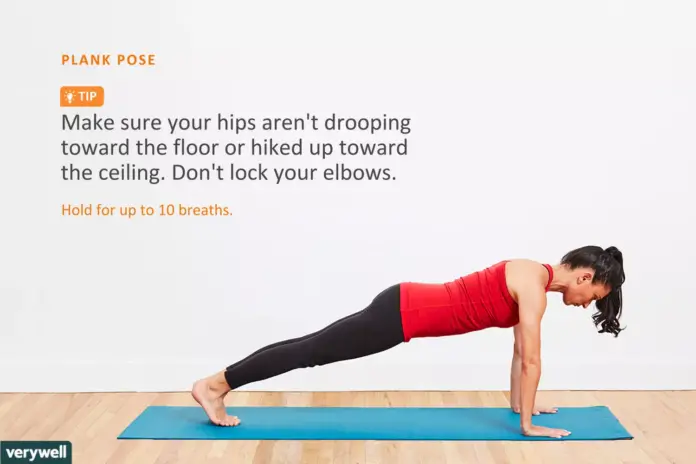

Planking has numerous advantages since it’s a great core and abdominal exercise. To ensure you keep your core strong and stable, add the move to your ab workout program. Keep reading to find out plank exercise benefits and different variations along with instructions. How to Do a Plank: Proper Form, Variations, and Common Mistakes
What Is a Plank?
A plank involves balancing on toes and forearms as you hold the rest of your body off the ground. Your spine is kept in a neutral position and your head, torso, and legs are aligned. Planking is an isometric exercise since keep your core muscles contracted in one position.
How to Do a Plank
Choose a posture that allows you to fully stretch your body’s length. Using a yoga mat or exercise mat will give you enough padding to be comfortable on all fours. You can choose whether to perform a plank on your palms or your forearms, as shown in the video. A variety of wrist wraps are available to provide joint support. How to Do a Plank: Proper Form, Variations, and Common Mistakes
- Step 1: Begin in the plank position, face down with your forearms and toes on the floor. Your elbows are directly under your shoulders and your forearms are facing forward. Your head is relaxed and you should be looking at the floor.
- Step 2: Engage your abdominal muscles, drawing your navel toward your spine. Keep your torso straight and rigid and your body in a straight line from your ears to your toes with no sagging or bending. This is the neutral spine position. Ensure your shoulders are down, not creeping up toward your ears. Your heels should be over the balls of your feet. How to Do a Plank: Proper Form, Variations, and Common Mistakes
- Step 3: Hold this position for 10 seconds. Release to floor.
- Step 4: Over time work up to 30, 45, or 60 seconds.
Plank Benefits
Planking provides many physical benefits. Strengthening the core is an important aspect of any workout regimen. A strong and solid core looks and feels good. More significantly, though, it supports the body’s ability to power, balance, and stabilize itself throughout almost all other activities.
Core strength is the basis for all coordinated and powerful athletic movements. A strong core can reduce stress on the joints and allow you to achieve better posture.
The plank exercise can also be used as the basis for a core muscle strength and stability test. The plank is more of a strength-building exercise than a cardio exercise, but by engaging a range of muscles it can also help to boost your calorie burn. How to Do a Plank: Proper Form, Variations, and Common Mistakes
Plank Modifications and Variations
There are several variations of the plank that further work the core muscles to build strength and stability. There are also ways to modify it if you are a beginner.
Need a Modification?
If you find the plank difficult at first, try these two variations as you build up strength.
Tabletop Plank
Practice plank from a tabletop position by actively pressing into your hands and pulling your abs in, which will help you learn how to keep your spine neutral, as pictured. You can also tuck your toes under and practice lifting your knees slightly off of the floor. As you strengthen your core, performing a plank with your knees bent and raised will assist relieve some of the strain on your feet. How to Do a Plank: Proper Form, Variations, and Common Mistakes
Incline Plank
You can also do an incline plank with your forearms or palms resting on a bench or step. Place your forearms or palms on a flat, elevated surface with your elbows directly under your shoulders. Walk your feet back until your body forms a straight line on a diagonal. Pull your abs in as you tuck your tailbone slightly and actively press into your forearms or palms.
Up for a Challenge?
Try these variations to change up your plank and challenge your core strength even more.
Plank With Leg Lift
In order to perform a plank with a leg lift, start in plank position with your forearms and toes on the floor. To make this exercise a bit easier, you can perform the movement on your hands rather than your forearms. How to Do a Plank: Proper Form, Variations, and Common Mistakes
- Slowly raise one leg 5 to 8 inches off the floor
- Count to two and slowly lower your leg to the floor.
- Switch legs and repeat.
- Do two to three sets of 10 reps.
Plank With Arm Lift
Another way to add variety to the basic plank is to add an arm lift, either by pressing into the opposite forearm or palm. To perform a plank with an arm lift, follow these steps:
- Start in plank position.
- Carefully shift your weight to your right forearm (or palm).
- Extend your left arm straight out in front of you.
- Hold for three seconds while keeping your core tight.
- Slowly bring your arm back to starting position.
- Switch arms and repeat.
- Do two to three sets of 10 reps.
Sets of Shorter Planks
Rather than doing a single plank for 30 seconds or more, some exercise routines say there are good benefits for doing a 10- to 15-second plank, resting for 30 seconds, and doing three to five sets. Your total time spent in the plank in an exercise session should be 60 seconds or less. How to Do a Plank: Proper Form, Variations, and Common Mistakes
Common Mistakes
Avoid these errors to get the most out of this exercise and to avoid strain or injury.
- Arching your back: If you arch your back, you are not engaging your abdominals sufficiently and you are putting more of the weight onto your arms. Check to be sure you are keeping your shoulders down and wide.
- Sagging your hips: Your hips will start sinking once your abs have reached their fatigue limit. That’s a sign it’s time to end your plank. If it seems your hips are sagging from the beginning, try separating your feet a bit wider and focus on engaging your abs.
- Tilting your head up: Your neck should be in line with your body, not tilted up, which could strain the neck. Keep your gaze down at the floor. How to Do a Plank: Proper Form, Variations, and Common Mistakes
Plank Safety and Precautions
You should not do planks if you have a shoulder injury. If you feel shoulder pain, end the exercise. In pregnancy, planks are considered safe for most people though there may be a concern for placing stress on the abdominal wall.4 It may be best to modify the plank and do a side plank exercise or an incline plank. Talk to your doctor or physical therapist to see if this is an appropriate exercise.
Frequently Asked Questions
What muscles do planks work?
The plank exercise works the entire core, including the abdominal muscles that run from the pelvis along the spine and up to the shoulder girdle. How to Do a Plank: Proper Form, Variations, and Common Mistakes
Muscles worked during planks include:
- Rectus abdominis, or top layer of core muscles at front of the pelvis
- Transverse abdominis, or the deepest layer of core muscles that run horizontal like a corset
- Obliques, which are core muscles that run along your sides of your abdomen
- Erector spinae, which run along the length of your back
- Shoulder stabilizers, which support the shoulders
- Gluteus maximus, or the largest muscle of the buttocks and hips
- Quadriceps,which run along the front of the thighs
How many calories does planking burn?
How many calories burned depends on your weight and how long you hold the plank. Typically, a 150-pound individual will burn about 3 to 4 calories a minute holding a plank. How to Do a Plank: Proper Form, Variations, and Common Mistakes
What do planks help with?
Planks are great for building core strength and stability, which helps improve balance and coordination during everyday activities. A strong core can also support you during other forms of athletic or physical activity and can even help protect your lower back from injury.