
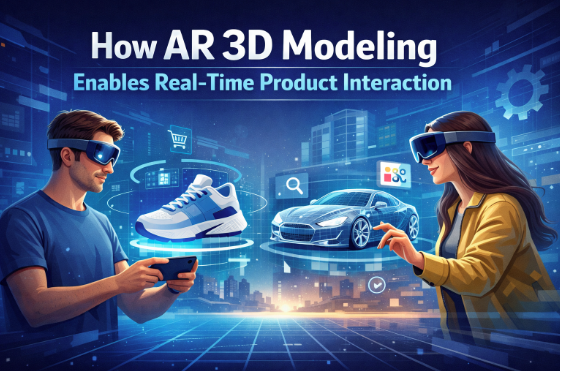

In today’s rapidly innovating digital world, customers desire more than just to view. Companies have therefore begun to offer interactive augmented reality experiences, which meet this demand for a better product experience and provide a more engaging shopping experience.
AR 3D modeling services make it simpler to offer this experience right to the customer, who can then rotate, zoom, place, and otherwise view virtual products in real time.
What is Real-Time Product Interaction?
Real-time product interaction is the ability of a user to instantly and flexibly control a digital product. This means that users can explore the interior of a 3D model and see it from any angle, interacting with it as they like, either on a screen with a mouse, on a mobile device with their finger, or in an AR environment.
Real-time interactions are especially revolutionary for eCommerce, which has always suffered from the inability to physically touch and test the product.
How Can 3D Models Enable Real-Time Interaction?
All successful AR experiences rely on a precise 3D model of whatever product or environment the user will interact with. These 3D models are developed using precise geometry and high-quality textures and materials in order to be a precise digital representation of the real product.
Once these 3D models are developed and integrated into AR experiences, they can be instantly controlled by user input while also considering environmental factors such as lighting and size.
The quality of these 3D models is of utmost importance in order to convey a realistic non-verbal communication that will improve the user experience. This means that the shadows, reflections, and materials of 3D models should behave in such a manner in real-world applications so that the user experience of AR is not gimmicky but rather realistic.
How Does 3D Modeling Enhance User Engagement?
The level of engagement that 3D modeling offers is far beyond the level of engagement offered by any traditional media because the user is actively involved.
Rather than just watching a commercial or browsing images, an actively engaged user who engages with a 3D model of a product is more likely to remember the product and to identify with a brand.
This can be done in a variety of ways; in some instances, a user may be able to change the shape, location, and size of a shopping cart. In other instances, they may be able to zoom in on the minute details of a virtual athletic shoe.
Because of the interactive nature of the experience, users are more likely to purchase similar products in the future and share their shopping experience with others.
Visualizing in Real Time
Another advantage of AR is the capability to visualize in real-time. As the user moves the product around in roomscale or other ways, whatever change they make will be reflected in real-time so that the user can come to a decision as quickly as possible, with absolute confidence.
Moreover, the AR 3D models are created to give a quick and accurate response to user input, such as finger drag or hand movement, to the speed of rotation.
How Does 3D Modeling Help Reduce Returns?
One of the most frustrating things about modern eCommerce is the difficulty of managing and understanding customer expectations. Customers often purchase an item only to return it after realizing that it is impossible to incorporate it into their environment and use it as they had intended.
The AR 3D model removes much of the confusion by allowing a customer to view a product before they purchase it, reducing the margin of error and raising the confidence level of the interaction. The AR 3D model is very useful in reducing returns of heavy items such as furniture and machines, as well as high-end or custom items such as designer clothing and ceramics.
How Else Can Industries Benefit From Real-Time AR Interaction With 3d Models?
There are many other industries that use AR 3D models for real-time interaction in their experiences.
- Manufacturers utilize 3D models of parts and machines to enable a thorough client examination prior to manufacturing.
- Realtors utilize 3D models of interior designs and furniture to enable an immersive house tour experience.
- Educators leverage AR to enable students to zoom in and out of 3D models of literal or figurative concepts to foster a better understanding.
- Medical professionals leverage 3D models to enable non-technical viewers to understand complex physiological events.
In any sector, a skilled 3D modeling team can create assets for optimal AR performance.
How Do New Platforms Leverage 3D Models with Native Augmented Reality?
Augmented reality experiences are now able to be launched from mobile platforms and web browsers, which means that any individual, regardless of their own hardware capabilities, can access AR experiences via a simple web link or mobile URL. Tools such as Web AR and AR Kit are major contributors to this advancement, as well as very detailed visual depictions of products to prepare them for any device.
A high-quality 3D asset can be optimized to perform extremely well on many platforms with little lag.
How Can AR 3D Modeling Provide a Competitive Advantage?
Companies that offer experiences as well as products will be even more competitive than before. Interactive experiences demonstrate that the company is concerned about the viewer’s level of understanding and comfort with a purchase, and can help to establish trust with their customers.
Also, companies can use AR to gain insights about how potential customers interact with a product, where they focus their attention, and how they might change the product in the future.
By continuing to invest in AR experiences, brands are preparing for a future of digital engagement that will exceed the standard of a typical shopping experience.
Conclusion
AR 3D modeling in a real-time interaction environment also encourages viewers to become more involved in products by turning passive viewers into active participants. Companies that adopt these experiences today will have a competitive advantage that will only become more valuable when they become the norm.
Without high-quality 3D content to power their augmented reality experiences, no company will be able to fully capitalize on new and emerging platforms for improved branding and consumer knowledge.